Sunday, January 31, 2021

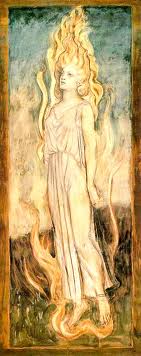
Brigid -- A Flame for the Future


Brigid, A Flame for the Future

The following is an excerpt from my book, Lady of the Sea: The Goddess Who Births the New Age, and it has to do with Brigid’s role in the future. I have provided translations for the Gaelic words.

An interesting story concerning Brigid is found in the writings of 19th century writer Fiona Macleod (William Sharp). It comes from a little volume called Winged Destiny: Studies in the Spiritual History of the Gael. In this story the author encounters an elderly woman named Mary MacArthur who tells him of a dream encounter she’d had with St. Brigid many years before. Brigid was very precious and dear to the Celts; they regarded her as the foster mother of Christ, and this dream encounter touched Mary MacArthur deeply.

This was the dream that Mary MacArthur recounted to Fiona Macleod.

A woman of great beauty came up to Mary as she was at the seashore gathering driftwood to  kindle her fire. The woman threw the wood into the sea, saying she was throwing away Mary’s sorrows with the wood. She identified herself as Brigid, and Mary exclaimed aloud in wonder and praise, and went down on her knee. Brigid looked at her and said:

I am older than Brighid of the Mantle, Mary,
and it is you that should know that.
I put songs and music on the wind
before ever the bells of the chapels were rung in the West
or heard in the East.

I am Brighid-nam-Bratta (Brighid of the Mantle),
but I am also Brighid-Muirghin-na-tuinne (Brighid of the conception of the waves),
and Brighid-sluagh (Brighid of the immortal host),
Brighid-nan-sitheach seang (Brighid of the slim faery folk),
Brighid-Binne- Bheullbuchd-nan-trusganan-uaine (Brighid of sweet songs and melodious mouth),

and I am older than Aona (Friday)
and am as old as Luan (Monday).

And in Tir-na-h'oige (Land of the Ever Young)
my name is Suibhal-bheann (Mountain traveler);
in Tir-fo-thuinn (Country of the Waves)
it is Cù-gorm (Grey Hound);
and in Tir-nah'oise  (Country of Ancient Years)
it is Sireadh-thall (Seek-beyond).

And I have been a breath in your heart.

And the day has its feet to it that will see me
coming into the hearts of men and women
like a flame upon dry grass,
like a flame of wind in a great wood.

For the time of change is at hand, Mairi nic Ruaridh Donn—
though not for you, old withered leaf on the dry branch,
though for you, too, when you come to us and see all things in the pools of life yonder.”


This interesting passage, wherein Brigid refers to a time of change close at hand, would seem to speak of the Aquarian Age which is now arriving, as well as the major time of changes we are living through today as we are led into this New Age.

Older than Friday—creation’s final day, when all living creatures came into being—and as old as Monday—the second day of creation, when God began the work of creation by separating the waters of above and below, thus creating sky and sea, Brigid is telling us she is older than earthly life and was there at the very beginning, much like the feminine figure of Wisdom in the Bible.

She is Lady of the faeries, the sea, and the songs in the wind. Brigid says that she has previously been like “a breath in your heart,” but that the time is coming when she will enter into people’s hearts like a flame upon dry grass and a flame of wind in a great wood.

Thus she identifies herself as a major player in the future; a powerful being who will help bring about, in times to come, the very changes she foretells. 

My feeling about this message to Mary McArthur is that it is one more sign of the return of the Divine Feminine. Her importance can no longer be denied. Her messages must be heard... and heeded.


Labels:

Friday, January 31, 2020

A Call of Welcome to Brigid

Brigid, Goddess and Saint

Brigid Statue and Well, (c) Abigail Jones, 2004
Brigid was Ireland’s most beloved goddess. As such she made the transition into the Christian era as St. Brigid, her legends and lore becoming attached to St. Brigid of Kildare, founder of the religious community Kildare - the Church of the Oak in the 5th century CE.

When studying the information about the Goddess Brigid it important to recall that although legends and stories undoubtedly abound, none were written down until the Christian era, and these were written by the educated class, usually monkish scribes in Christian monasteries.

Another thing to note is that the ideas and imagery of the goddess have been so thoroughly mixed with that of the saint that the two are impossible to untangle, particularly at this remove in time. Although St. Brigid of Kildare was an actual historical personage, it is evident that the legends of the Goddess Brigid were transferred to the saint and painted with a Christian veneer.  Or as Sir James Frazier wrote in The Golden Bough, “St Bridget is an old heathen goddess of fertility, disguised in a threadbare pagan cloak.”  (p. 177)

We find first mention of Brigid in Cormac’s Glossary, an Irish document written by one Cormac  mac Cuillenain in the ninth century, although he undoubtedly drew upon earlier source material. From Cormac we learn that Brigid was the daughter of the great Irish god called the Dagda, and that she was “a woman of learning” whom the poets and seers worshiped, for her protection and care were known to be quite wonderful. Cormac tells us that she had two sisters, also named Brigid, one of whom was a woman of healing - a female physician - the other being a woman of smithcraft - a female smith.  Since triple deities were common in Celtic cultures, it is thought that these three Brigids actually represent one goddess - the triple aspect Brigid of poetry, healing and smithcraft. 


   The Fair Maid of February

In the Gaelic lands, January 31/ February 1 was the Feast of Brigid – originally a feast of the goddess Brigid, but later in time, the feast of the St Brigid of Kildare.

The Feast of Brigid was seen as the beginning of season of spring, and was also known as Imbolc, which means “ewe’s milk — a  reference to the fact that it was the time that lambs were born  — and  Oimelc, which means “in the belly,” referring to the new growth and life that was now emerging from the belly of the earth. 

 Divination practices were common at this time of year, as were purification rituals. The word “February” comes from the Latin, Februum, which means “purification,” and in the Rome Empire, purification rituals were held at this time. All this divining and purifying was to prepare for the new year ahead, as February was, till about 450 B.C., the last month of the year.


A Call of Welcome


Brigid of the East – Air!  
Breath of life, you are Inspiration, beloved goddess-saint-muse of bards and poets! You are the first breath of Spring, and  first breath of life. We celebrate the breath of new life at your festival, Imbolc, when the snowdrop tells us the life of the earth is returning. Brigid, you are welcome among us!

Brigid of the South – Fire!  
Flame of life, you are the warming and illuminating Hearthfire of life. You are the fiery energy of expansion and growth, the fire in our head, heart, hearth, sun, stars, and earth, the spark of divine life in all that lives.  Brigid, you are welcome among us!

Brigid of the West – Water! 
Water of Life, you are the Flow of life. You are the coursing current of rivers, streams, the upwelling springs, and the deep underground rivers of life the feed that wells of earth. You are the flow of thoughts, emotions, and of our very life’s blood. Brigid, you are welcome among us!

Brigid of the North – Earth!  
Substance and Structure of life, you are the web upon which we are woven, the structure that holds us together. Your mantle is the earth upon which we live. The daily tasks of life –  the sublime reality of birth & death, the milk of cow and sheep, the grass and grain in the field – are your sacred province. Brigid, you are welcome among us!

Brigid of the Center 
You are Breath, Flame, Flow, and Substance, and all of them woven together, the very Fabric of Life! Refresh us as we move into the new cycle of life in this new year. Grant us inspiration; rekindle our inner flame, stir and strengthen our inner waters, and ground our efforts to bring positive change to the world. Dear Brigid, you are welcome among us!
(c) Margie McArthur, 2015

Brigid's Well, (c) Abigail Jones, 2004
 A Blessing

Blessed Brigid, Flame of Delight in the many worlds,
May the fires of your Sacred Hearth be rekindled.
May they burn brightly, their flames bridging the many worlds,
Bringing the starpower of the Heavens down to enliven
The stars that live deep within the heart of Mother Earth.

Grant us the gift of your brightness and warmth:
The fire that is inspiration.
Let us draw sustenance from your Well of Deep Peace,
That nourishes all of Life.

Enfold us in your mantle of protection and healing.
Guide us as we heal, and in our creative endeavors.
Grant us the inspiration that enables
The creation of True Beauty and Harmony.

Blessed One, Fair One,
This do we ask of you,
As we offer you the Inextinguishable Light
Of our love and homage.
(c) Margie McArthur

A Song
 Lá Fhéile Bríde — The Festival Day of Bríd

https://www.youtube.com/watch?v=oEieym5uI7k


Labels:

Thursday, February 01, 2018

Happy Brigid's Day!


The Wheel of the Year has once again returned to the Festival Day of the Blessed Brigid, goddess and saint. This day was considered to be the beginning of Spring. Here are a few things to help you celebrate this day.

An Invocation for Brigid

Brigid of the East – Air 
Breath of life, you are Inspiration, the beloved goddess-saint-muse of bards and poets! You are the first breath of Spring, and  first breath of life. We celebrate the breath of new life at your festival, Imbolc, when the snowdrop tells us the life on the earth is returning. 
Brigid, you are welcome among us!

Brigid of the South – Fire 
Flame of life, you are the warming and illuminating Hearthfire of life. You are the fiery energy of expansion and growth, the fire in our head, heart, hearth, sun, stars, and earth, the spark of divine life in all that lives.  
Brigid, you are welcome among us!

Brigid of the West – Water
Water of life, you are the Flow of life. You are the coursing flow of rivers, streams, and the deep underground rivers of life that feed the wells of the earth. You are the flow of thoughts, emotions, and of our very life’s blood. 
Brigid, you are welcome among us!

Brigid of the North – Earth
Structure and substance of life, you are the web upon which we are woven, the structure that holds us together. Your mantle is the earth upon which we live. The daily tasks of life, the sublime reality of birth and death, the milk of the cow, the grass and grain in the field. 
Brigid, you are welcome among us!

Brigid of the Center
You are Breath, Flame, Flow, and Substance, and all of them woven together, the very Fabric of Life! Refresh us as we move into the new cycle of life in this new year. Grant us inspiration; rekindle our inner flame, stir and strengthen our inner waters, and ground our efforts to bring positive change to the world. 
Dear Brigid, you are welcome among us!
(c) Margie McArthur, 2017

* * *

Words of St Brigid
“I would like the angels of Heaven to be among us. I would like an abundance of peace. I would like full vessels of charity. I would like rich treasures of mercy. I would like cheerfulness to preside over all. I would like Jesus to be present. I would like the three Marys of illustrious renown to be with us. I would like the friends of Heaven to be gathered around us from all parts. I would like myself to be a rent payer to the Lord; that I should suffer distress, that he would bestow a good blessing upon me. I would like a great lake of beer for the King of Kings. I would like to be watching Heaven’s family drinking it through all eternity.”
~ St. Brigid of Ireland

* * * 

And here is a lovely song about Brigid
  
Lá Fhéile Bríde — The Festival Day of Bríd


Labels:

Sunday, January 31, 2016

The Feast of Brigid

Artwork (c) Miranda Gray
 
The winter rains have come at last to the parched lands of California, and the earth is glad again.

Everything that was grey and brown has greened up. Dandelions are springing up everywhere and seem an especially vibrant green right now.

Dandelions are one of Brigid’s flowers, so this reminds me that her feast day is near at hand. The Midwinter-born light has increased; now is the time of the emergence of a new cycle of life — lambs are born and ewe’s milk flows; snopdrop flowers push through the snow and herald the Spring that is to come. Life is renewed, and it's time for a new start. And like groundhogs, badgers, and bears, it’s time for us to wake up, crawl out of the cave and look around — to see what the future might hold!

Here is a prayer to Brigid that I wrote many years ago.

Blessed Brigid
Blessed Brigid, Flame of Delight in the many worlds,
May the fires of your Sacred Hearth be rekindled.
May they burn brightly, their flames bridging the many worlds,
Bringing the star-power of the Heavens down to enliven
The stars that live deep within the heart of Mother Earth.

Grant us the gift of your brightness and warmth:
The fire that is inspiration.
Let us draw sustenance from your Well of Deep Peace,
That nourishes all of Life.

Enfold us in your mantle of protection and healing.
Guide us as we heal, and in our creative endeavors.
Grant us the inspiration that enables
The creation of True Beauty and Harmony.

Blessed One, Fair One,
This do we ask of you,
As we offer you the Inextinguishable Light
Of our love and homage.


Here is a lovely video to help you celebrate the day  —  La Fheile Brid

Blessings of Brigid to all! 


Labels:

Sunday, February 01, 2015

Blessed Brigid - the Golden Sparkling Flame


Today is the feast of the Brigid, the Holy Woman, whose name means High One, or Exalted One. She was said to be a protector of women in childbirth, and was associated with the welfare of livestock. Her festival, February 1st, is associated with the lambing season.
In the insular Celtic countries Spring began on this day, which was also referred to as Oimelc (ewe’s milk). The very next day, February 2nd, was the Christian feast of Candlemas, which was really the church’s observance of the much older feast of Imbolc/ Oimelc/Brigid—a feast of fire and light at a time when the dark of winter is giving way to the light of spring. The baby lambs were born around this time. It was, therefore, a time of new light, new life, new milk, new nourishment. Interestingly, February 3rd is the feast of a saint with the interesting name of “Blaise,” and is a day when candles are blessed for the liturgical year, and the congregation comes forward to have their throats blessed (for protection against choking) by a priest, who used two candles in an X shape—exactly the shape of Brigid’s Cross—to do this.
Brigid has been honored at this time of year for a very long time, first as Goddess and later as Saint. She was particularly honored by women, whose rituals at this time of year—recorded by folklorists—involved inviting Brigid back to the world to bring her light, warmth, fertility and prosperity. A special bed was prepared for her, and omens of future life and prosperity were taken from the evidence of whether or not she was seen to have arrived and slept in her bed.
There is much fire symbolism in the stories of St. Brigid, and many of these stories are thought to derive from the older, pagan stories of the Goddess Brigid, who was sometimes addressed as the golden, sparkling flame.

Brigid's Fire Temple, Kildare, (c) Abigail Jones
According to legend, a perpetual fire burned in her precinct at a place later known as Kildare, the Church of the Oak. This fire was tended by 19 priestesses—similar to the Roman national hearth tended by the Vestal Virgins. Like many other holy fires of legend, it was said to burn without producing ash. The 19 priestesses cared for the fire for 19 nights, but it was thought that Brigid herself tended the flame on the 20th night. When Christianity came to be the religion of the land, it was St. Brigid who was honored and Christian nuns who tended the flame.
Brigid was a triple goddess: she was sometimes said to have two sisters also named Brigid. They they were matron goddesses of healing, of poetry—with which seership was connected—and of crafts, particularly those associated with fire, such as metal-smithing and perhaps pottery. In addition, the legends show Brigid to be associated with that borderlands/ liminality/threshold state that clearly links her to the Otherworlds, including the world of Faery. Her association with these liminal states is shown in her St. Brigid legends by the fact that she was born at sunrise and while her mother was straddling a threshold. It is shown in her Goddess legends by the fact that she was of the Tuatha De Danann, yet married to a Fomorian. Perhaps it is also illustrated by the fact that her cult also straddled two religious traditions, and made an easy transition from Paganism to Christianity.

Brigid statue and arch by Brigid's Well, Kildare, (c) Abigail Jones


Brigid's Well, Kildare (c) Abigail Jones
Brigid is associated with water as well as fire, and many healing wells are sacred to her throughout the British Isles. Places where water emerges from the Earth are always considered thresholds between the worlds—the Underworld and Middleworld in this case. As a goddess of healing associated with seership and liminal states of being, she is uniquely suited to be the especial Matron Goddess of Faery Healing
from
Faery Healing: The Lore and the Legacy, Chapter 15

Labels:

Wednesday, February 01, 2012


Brigid, A Flame for the Future 

The following is an excerpt from my upcoming book, Lady of the Sea: The Goddess Who Births the New Age, and it has to do with Brigid’s role in the future. I have provided translations for the Gaelic words.
An interesting story concerning Brigid is found in the writings of 19th century writer Fiona Macleod (William Sharp). It comes from a little volume called Winged Destiny: Studies in the Spiritual History of the Gael. In this story the author encounters an elderly woman named Mary MacArthur who tells him of a dream encounter she’d had with St. Brigid many years before. Brigid was very precious and dear to the Celts; they regarded her as the foster mother of Christ, and this dream encounter touched Mary MacArthur deeply.

This was the dream that Mary MacArthur recounted to Fiona Macleod. A woman of great beauty came up to Mary as she was at the seashore gathering driftwood to  kindle her fire. The woman threw the wood into the sea, saying she was throwing away Mary’s sorrows with the wood. She identified herself as Brigid, and Mary exclaimed aloud in wonder and praise, and went down on her knee. Brigid looked at her and said:

I am older than Brighid of the Mantle, Mary,
and it is you that should know that.
I put songs and music on the wind
before ever the bells of the chapels were rung in the West
or heard in the East.

I am Brighid-nam-Bratta (Brighid of the Mantle),
but I am also Brighid-Muirghin-na-tuinne (Brighid of the conception of the waves),
and Brighid-sluagh (Brighid of the immortal host),
Brighid-nan-sitheach seang (Brighid of the slim faery folk),
Brighid-Binne- Bheullbuchd-nan-trusganan-uaine (Brighid of sweet songs and melodious mouth),

and I am older than Aona (Friday)
and am as old as Luan (Monday).

And in Tir-na-h'oige (Land of the Ever Young)
my name is Suibhal-bheann (Mountain traveler);
in Tir-fo-thuinn (Country of the Waves
it is Cù-gorm (Grey Hound);
and in Tir-nah'oise  (Country of Ancient Years)
it is Sireadh-thall (Seek-beyond).

And I have been a breath in your heart.

And the day has its feet to it that will see me
coming into the hearts of men and women
like a flame upon dry grass,
like a flame of wind in a great wood.

For the time of change is at hand, Mairi nic Ruaridh Donn—
though not for you, old withered leaf on the dry branch,
though for you, too, when you come to us and see all things in the pools of life yonder.”

*  *  *


This interesting passage, wherein Brigid refers to a time of change close at hand, would seem to speak of the Aquarian Age which will soon arrive, as well as the major time of changes we are now experiencing and which are leading us into the new age.

Older than Friday—creation’s final day, when all living creatures came into being—and as old as Monday—the second day of creation, when God began the work of creation by separating the waters of above and below, thus creating sky and sea, Brigid is telling us she is older than earthly life and was there at the very beginning, much like the feminine figure of Wisdom in the Bible.

She is Lady of the faeries, the sea, and the songs in the wind. Brigid says that she has previously been like “a breath in your heart,” but that the time is coming when she will enter into people’s hearts like a flame upon dry grass and a flame of wind in a great wood.

Thus she identifies herself as a major player in the future; a powerful being who will help bring about, in the age to come, the very changes she foretells.

Labels:

Tuesday, January 31, 2012


The Genealogy of Brigid 
 The genealogy of the holy maiden Bride,
Radiant flame of gold, noble foster-mother of Christ,
Bride the daughter of Dugall the brown,
Son of Aodh, son of Art, son of Conn,
Son of Crearar, son of Cis, son of Carina, son of Carruin.

Every day and every night
That I say the genealogy of Bride,
I shall not be killed, I shall not be harried,
I shall not be put in cell, I shall not be, wounded,
Neither shall Christ leave me in forgetfulness.

No fire, no sun, no moon shall burn me,
No lake, no water, nor sea shall drown me,
No arrow of fairy nor dart of fay shall wound me,
And I under the protection of my Holy Mary,
And my gentle foster-mother is my beloved Bride.


*******

Here is a short video where a sweet young lady will teach you how to make a Brigid's Cross.

Labels:

Monday, January 30, 2012

Brigid's Well, Ireland


And here is a lovely song:


Brigid Upon the Highland

Labels:

Sunday, January 29, 2012


And here is a lovely song to Brigid, sung in Gaelic:

http://www.youtube.com/watch?v=AqN3XAqoFDg&feature=related

Labels:

Friday, January 27, 2012

Thursday, January 26, 2012

Brigid's Feast Will Soon Be Here! 


The hours of daylight are growing and we are rapidly approaching the festival of Brigid – Goddess and Saint. I have posted information about Brigid in the past:

*   http://margiemcarthur.blogspot.com/2011/02/la-fheile-bride-better-late-than-never.html
*   http://margiemcarthur.blogspot.com/2010/01/la-fheile-bride-it-is-once-again-feast.html
*   http://margiemcarthur.blogspot.com/2008/01/oimelc-imbolc-and-feast-of-brigid-this.html
*   http://margiemcarthur.blogspot.com/2007/02/blessed-brigid-golden-sparkling-flame.html

But this year I’d like to share with you some lovely pictures, videos, and websites about Brigid that I’ve found.

Here is today’s offering.


http://www.youtube.com/watch?v=6mpuu18cZpY&feature=related

There will be something new each day, so please return and check them all out!


Lá Fhéile Bríde!    

Margie

Labels:

Thursday, February 17, 2011


Lá Fhéile Bríde!
(better late than never?)

In honor of this month of Brigid, I'd like to share this exquisite Irish television program with you.

BRIGHID


Part One

Part Two

Labels:

Sunday, January 31, 2010

Lá Fhéile Bríde!

It is once again the feast day of the great saint and goddess Brigid! In honor of this occasion I'd like to share an excerpt from my forthcoming book ---
Lady of the Sea: The Goddess of the Sea and Stars
(c) Margie McArthur, 2002-2009, All rights reserved

An interesting story concerning Brigid is found in the writings of 19th century writer Fiona Macleod. (1) In this story the author encounters an elderly woman named Mary MacArthur, who tells him of a dream encounter she’d had with St. Brigid many years earlier. Brigid was very precious and dear to the people of Scotland and Ireland. They regarded her as the foster mother of Christ, and this encounter touched Mary McArthur very deeply.

This is the dream that Mary MacArthur recounted to Fiona Macloed. A woman of great beauty came up to her as she was at the seashore gathering driftwood to kindle her fire. The woman took the wood and threw it into the sea, saying she was throwing away Mary’s sorrows with the wood. She identified herself as Brigid, and Mary exclaimed aloud in wonder and praise, and went down on her knee in respect. Brigid looked at her and said:

“I am older than Brighid of the Mantle, Mary, and it is you that should know that. I put songs and music on the wind before ever the bells of the chapels were rung in the West or heard in the East. I am Brighid-nam-Bratta (Brighid of the Mantle), but I am also Brighid-Muirghin-na-tuinne (Brighid of the conception of the waves), and Brighid-sluagh (Brighid of the immortal host), Brighid-nan-sitheach seang (Brighid of the slim faery folk), Brighid-Binne-Bheullbuchd-nan-trusganan-uaine (Brighid of sweet songs and melodious mouth), and I am older than Aona (Friday) and as old as Luan (Monday).

And in
Tir-na-h'oige (Land of the Ever-Young) my name is Suibhal-bheann (mountain traveler); in Tir-fo-thuinn (Country of the Waves) it is Cù-gorm (grey hound); and in Tir-nah'oise (Country of Ancient Years) it is Sireadh-thall (seek-beyond). And I have been a breath in your heart.

And the day has its feet to it that will see me coming into the hearts of men and women like a flame upon dry grass, like a flame of wind in a great wood. For the time of change is at hand, Mairi nic Ruaridh Donn—though not for you, old withered leaf on the dry branch, though for you, too, when you come to us and see all things in the pools of life yonder.”


This interesting passage, in which Brigid refers to a time of change close at hand, would seem to speak of the Aquarian Age which will soon arrive, as well as the major time of changes we are now experiencing and which are leading us into the new age.

Older than Friday—creation’s final day, when all living creatures came into being—and as old as Monday—the second day of creation, when God began creation by separating the waters, creating sky and sea, Brigid is telling us she is older than all earthly life and was there at the very beginning of things.

She is Lady of the Faeries, the sea, and the songs in the wind. Brigid says that she has previously been like “a breath in your heart,” but that the time is coming when she will enter into people’s hearts like a flame upon dry grass and a flame of wind in a great wood.

Thus she identifies herself as a major player in the future; a powerful being who will help bring about the very changes she foretells.

(1) Macleod, Fiona; Winged Destiny: Studies in the Spiritual History of the Gael; pp 207-209

Labels:

Friday, February 08, 2008


Ella Young - Elfland's Ambassadress


In this season of Brigid I am reminded of something that happened years ago.

In the early 1990's I was assistant editor of an earth-mysteries magazine called Dragon’s Quest. One day a very interesting article was submitted for possible publication. It was about an author called Ella Young and was titled Carmel Magic. It was written by a man named John Thompson.

Several years prior, while doing some magical work out on the land, I’d experienced some very strong Celtic energies. I found this puzzling, since I live in central, coastal California, and one would expect that I would have picked up on energies of the native cultures of the area rather than those from thousands of miles of continent and ocean away! But nonetheless, there they were. In particular, the energies of the goddess Brigid were very strong.

John’s article solved the mystery for me. Although I knew who Ella Young was, and indeed, owned her Celtic Wonder Tales, I had no idea that she had, in the 1920s, moved to an area quite geographically close to my present location, and had passed on her legacy of Irish magic to her new friends there. I had no idea that she had gathered this group of people around her and taught them about the Old Gods—Brigid, Lugh, Dana, Manannan and the rest—and about the faery folk and the other spirits of the invisible realms. Mystic that she was, she had a strong awareness of presence of these invisible realms and the beings who inhabited them, and taught her new students that nature was sacred and must be protected, and that the plants, the trees, the land, and the ocean all contained unique spirits with whom humans could communicate and from whom they could learn. Thus, she was not only one of the earliest American pagans of the 20th century, she was an early environmentalist as well.

While in Ireland Ella had been part of a magical group called the Fellowship of the Four Jewels. The jewels referred to were the four sacred treasures of the Tuatha De Danaan of Ireland—the Sword of Light of Nuada, the Spear of Lugh, the Cauldron of the Dagda, and the Stone of Fal (also called the Stone of Destiny). These treasures, in actuality, represented the powers of the land of Ireland itself. When Ella came to the USA and connected with the sacred lands in California, she quite naturally modified her focus to the land of California, while still using the magical structures and Celtic deities with whom she had worked before. So the Fellowship of the Four Jewels became the Fellowship of Shasta, with Brigid as its main deity. Ella dearly loved Brigid, whom she looked upon as the Earth Goddess herself, and it was to Brigid that the rites of the four yearly festivals performed by the Fellowship were dedicated.

Whatever work the Fellowship had done through the years of its existence (from 1931 till Ella’s death in 1956, and from 1960 till the death of her successor Gavin Arthur in 1972), it had certainly left its energetic mark within the lands of the central coast of California!

Learning that Ella Young had lived and worked so close to my own area inspired me to search out her autobiography, Flowering Dusk. I also read other works that mentioned her. I was interested to learn that she felt the area around Point Lobos, not far south of where I live, was the center of psychic force for the entire Pacific coast of America. About Point Lobos Ella said, “There are other sacred mountains, other sacred places, but this is the most powerful. But Point Lobos is not ready to make friends with society yet. Mount Shasta is making friends; other great mountains are making friends; but not Point Lobos. That is why people should be careful when they go to Lobos.” She said that when Lobos was ready to make friends, when its force was finally released, great things would happen in America.

She felt the other power spots along the nearby central coast all emanated from the Lobos area, and she often sat beneath the gnarled cypresses of Lobos, teaching her students about the powers and spirits of the earth, including the faeries right there at Point Lobos, and the great deva with beautiful wings who guarded the place. (1)

* * * * * * *

Several months after all this some old friends from Southern California drove up to visit me. They arrived much later than I’d expected, and I asked them what had taken them so long. They said they’d decided to take the coastal route I instead of the freeway. Then they asked me if I knew about that HUGE earth energy power point on the coast north of Big Sur and a bit south of the city of Carmel. They said it felt to them like a powerful dragon was in the land there. It was so strong they felt a need to pull over, park the car, get out, and make it an offering. I knew immediately that this had to be the Point Lobos area, and I told them what Ella had said about it.

Some time after that, my family and I were driving down the coast towards Big Sur for a Mother’s Day outing. My husband was driving; I had my nose in a book. Quite suddenly I became aware of a huge surge of power flowing into me. The word “dragon!” popped into my mind as my head automatically jerked around to see where the power was coming from. I found myself looking at some rolling hills quite close to the coast, and they looked for all the world like a dragon lying on its side, asleep. The energy was literally rolling out of those hills. I knew instantly that we must be in the Point Lobos area, and this was later confirmed when we passed a road sign.

Because Ella was an early environmentalist, when she moved to California and was introduced to redwood trees, she quickly formed relationships with them, and soon became very supportive of the Save the Redwoods League.

Ella Young died not long before Lughnasadh, 1956, in her home in Halcyon, CA, near San Luis Obispo. Her ashes were scattered in a redwood grove near St. Helena, in the Napa Valley. She had known her time of death was nigh, and died as she lived—a Druid Priestess.

Much of the proceeds from her literary estate were donated to the Save the Redwoods League.

If you haven’t had the pleasure of reading any of Ella Young’s book, start with her Celtic Wonder Tales, which may be found here.

The very first story, The Earthshapers (my favorite), tells of Brigid’s role in the shaping of the earth into a fair and beautiful place.

Enjoy!

Brigid’s Blessings to all!

(1) Rosalind Sharpe-Wall, A Wild Coast and Lonely, pp 187-188, Worldwide Publishing/Tetra, San Carlos, CA

Labels:

Thursday, January 31, 2008


~Oimelc, Imbolc, and the Feast of Brigid~


This evening the Feast of Brigid begins, so I’d like to share a bit about this wonderful goddess.

Brigid, beloved Celtic goddess, was well-known throughout the British Isles as the three-aspected goddess of poetry, smithcraft and healing. Occasionally the three aspects were portrayed as three sisters, all named Brigid—an example of the “triple” form so beloved of the Celts. She was sometimes said to be the daughter of the Dagda, the “All-Father” of the Tuatha De Danaan. In Ireland she was known as Brigid, in Scotland, as Brigid or Bride, and in Britain, she was known as Brigantia, goddess of the Brigantes of Northern England. Her name means Exalted One.

In spite of the fact that not many tales seem to have survived about her, she looms larger than life in the psyche of the Celts of the British Isles, and it is likely that her legends were juxtaposed onto those of the early Irish Christian saint of the same name, who, in Wales, was known as St. Ffraid.

Brigid’s feast day, which fell on February 1, was known as Oimelc or Imbolg. Cormac’s
Glossary tells us that Oimelc means ewe’s milk and refers to the fact that this is the time lambs are born. Because of this, Brigid is associated with milk and the animals that give milk.

Imbolc is variously translated as “in the belly” (a time of quickening/birthing) or “washing up.” Taken together, these names inform us that this festival was one of lactation and cleansing. Interestingly, the word “February” comes from to the Roman “Februa” which was a festival of washing and purification.

Brigid was, and is, the goddess of poetry, smithcraft, and healing, and the Fire that is behind them all—

Poetry: The fire of the mind and mind’s inspiration that sparks and ignites the poet’s creativity, Smithcraft: The tempering fire of the forge and the skill of the craftsman/woman.
Healing: The fires of life and body that must burn properly so that life may continue, and healing occur.

Each of these show themselves to be fires of creation and transformation. Thus, she is the pre-eminent deity-saint of Celtic Healing.

The stories, but particularly the customs and lore about Brigid in either her Pagan or Christian guise, inform us that we are dealing with a very powerful Being, one of the Old Ones, deeply connected with the primal powers of Life itself —fire, water, air, earth, origination, creation, formation, and manifestation, fertility and abundance. (from
Faery Healing, Chapter 1)

The legends of Brigid show her to be associated with that borderlands/liminality/ threshold state, which clearly links her to the Otherworlds, including faery. Her association with liminal states is shown in her St. Brigid legends by the fact that she was born at sunrise, and while her mother was straddling a threshold; it is shown in her Goddess legends by the fact that she was of the Tuatha De Danann, yet married to a Fomorian.

Brigid is associated with water as well as fire, and many healing wells are sacred to her throughout the British Isles, including a well near Glastonbury, and most well known, the well near Kildare in Ireland.

Places where water emerges from the earth are always considered thresholds between the worlds, the underworld and middleworld, in this case. As a goddess of healing associated with seership and liminal states of being, she is uniquely suited to be the especial matron goddess of Faery Healing. (from
Faery Healing, Chapter 15)

Brigid is, above all, the goddess of the hearthfire, and this is a good time of year to ask for her blessings on your own home’s hearth-and heart-center. Light a candle to Brigid tonight, and ask for her blessings.


Blessings of the growing light to you,
Blessings of the pure white snowdrop to you,
Blessings of the newborn lambs to you.
And may Brigid’s blessings bring you
Inspiration and deep healing.

Blessings,
Margie

Labels:

Thursday, February 01, 2007

Blessed Brigid - the Golden Sparkling Flame

Today is the feast of the Brigid, the Holy Woman, whose name means High One, or Exalted One. She was said to be a protector of women in childbirth, and was associated with the welfare of livestock. Her festival, February 1st, is associated with the lambing season.

In the insular Celtic countries Spring began on this day, which was also referred to as Oimelc (ewe’s milk). The very next day, February 2nd, was the Christian feast of Candlemas, which was really the church’s observance of the much older feast of Imbolc/ Oimelc/Brigid—a feast of fire and light at a time when the dark of winter is giving way to the light of spring. The baby lambs were born around this time. It was, therefore, a time of new light, new life, new milk, new nourishment. Interestingly, February 3rd is the feast of a saint with the interesting name of “Blaise,” and is a day when candles are blessed for the liturgical year, and the congregation comes forward to have their throats blessed (for protection against choking) by a priest, who used two candles in an X shape—exactly the shape of Brigid’s Cross—to do this.

Brigid has been honored at this time of year for a very long time, first as Goddess and later as Saint. She was particularly honored by women, whose rituals at this time of year—recorded by folklorists—involved inviting Brigid back to the world to bring her light, warmth, fertility and prosperity. A special bed was prepared for her, and omens of future life and prosperity were taken from the evidence of whether or not she was seen to have arrived and slept in her bed.

There is much fire symbolism in the stories of St. Brigid, and many of these stories are thought to derive from the older, pagan stories of the Goddess Brigid, who was sometimes addressed as the golden, sparkling flame. According to legend, a perpetual fire burned in her precinct at a place later known as Kildare, the Church of the Oak. This fire was tended by 19 priestesses—similar to the Roman national hearth tended by the Vestal Virgins. Like many other holy fires of legend, it was said to burn without producing ash. The 19 priestesses cared for the fire for 19 nights, but it was thought that Brigid herself tended the flame on the 20th night. When Christianity came to be the religion of the land, it was St. Brigid who was honored and Christian nuns who tended the flame.

Brigid was a triple goddess: she was sometimes said to have two sisters also named Brigid. They they were matron goddesses of healing, of poetry—with which seership was connected—and of crafts, particularly those associated with fire, such as metal-smithing and perhaps pottery. In addition, the legends show Brigid to be associated with that borderlands/ liminality/threshold state that clearly links her to the Otherworlds, including the world of Faery. Her association with these liminal states is shown in her St. Brigid legends by the fact that she was born at sunrise and while her mother was straddling a threshold. It is shown in her Goddess legends by the fact that she was of the Tuatha De Danann, yet married to a Fomorian. Perhaps it is also illustrated by the fact that her cult also straddled two religious traditions, and made an easy transition from Paganisn to Christianity.

Brigid is associated with water as well as fire, and many healing wells are sacred to her throughout the British Isles. Places where water emerges from the Earth are always considered thresholds between the worlds—the Underworld and Middleworld in this case. As a goddess of healing associated with seership and liminal states of being, she is uniquely suited to be the especial Matron Goddess of Faery Healing.

from
Faery Healing: The Lore and the Legacy, Chapter 15


Labels: